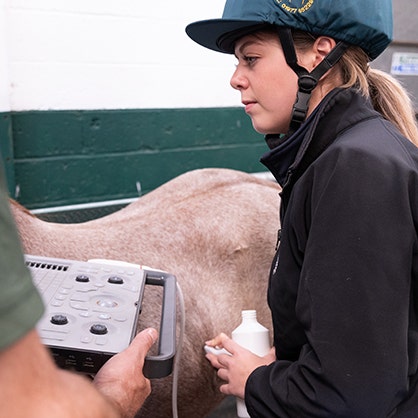
CVS has delivered a clinical improvement initiative across its equine division to strengthen the assessment of colic cases through the increased use of FLASH scanning - a rapid, structured abdominal ultrasound technique that enhances decision‑making during one of equine practice’s most common and high‑risk emergencies.
Colic remains a leading cause of emergency call‑outs in horses, presenting vets with the dual challenge of diagnosing the cause quickly and determining whether hospital referral is required. While traditional diagnostic approaches remain essential, FLASH scanning (Fast Localised Abdominal Sonography for Horses) has emerged as a valuable tool that provides additional, crucial real‑time information at the yard within minutes.
Recognising the potential of FLASH scanning to improve triage, communication and clinical confidence, CVS launched a structured project in early 2025 to better understand current usage across its practices and to strengthen competence throughout its equine ambulatory teams.
The project began within the CVS Equine Quality Improvement Group, with a survey led by QI representatives across 21 equine practices, gathering responses from 93 vets - around half of the organisation’s equine clinicians.
The data revealed striking variation in confidence levels: only 28% felt competent performing FLASH scans, 48% felt moderately competent and 24% reported not feeling competent at all. Importantly, 65% of those who felt competent expressed a desire for further training, highlighting both the complexity of colic assessment and the profession’s enthusiasm for continued development.
In response, CVS designed a comprehensive, hands‑on training programme. Working in partnership with IMV Imaging, regional training days were delivered in 2025, attended by 50 equine vets. These practical sessions focused on technique, image interpretation and integrating FLASH findings into case based decision‑making. Participants valued not only the technical instruction but also the opportunity to collaborate with CVS Equine colleagues from across the UK, fostering collaboration and support between ambulatory equine vets from different practices.
Alongside training, CVS is also addressing a key barrier to uptake: equipment availability. While FLASH scanning can be performed using standard ultrasound machines already present in all CVS equine practices, the organisation has started using handheld wireless ultrasound “V scanners”. These portable devices connect to mobile phones or tablets, enabling more vets to carry modern diagnostic equipment in their cars and undertake rapid imaging during colic examinations. This aligns with CVS’ wider commitment to modernising equine ambulatory care and ensuring diagnostic tools are accessible wherever horses are treated.
Early indicators suggest the initiative is already influencing clinical behaviour. With training continuing throughout 2025, the division has seen a 21% increase in FLASH scanning during colic call‑outs. Clinicians report that incorporating the technique has improved diagnostic certainty, supported clearer client communication and increased confidence in determining whether cases require referral.
Charlotte Sinclair, CVS Equine Veterinary Medical Director, said:
The next phase of the project will involve gathering follow‑up data in 2026 to evaluate changes in clinician confidence and scanning frequency. CVS plans to continue expanding access to handheld devices and offering additional training opportunities, embedding FLASH scanning as a routine part of colic assessment across its equine network.
CVS Equine provides a complete range of industry-leading veterinary services at 21 sites across the UK as well as its out-of-hours clinical and call answering services, Equicall and Equicomms. Its ambulatory veterinary surgeons are supported by a team of over 20 recognised Veterinary Specialists in internal medicine, surgery, dentistry, sports medicine, reproduction and diagnostic imaging based within a network of referral centres. The division offers a multi-disciplinary approach, along with the latest veterinary treatments, diagnostic services, advice, standards and support – as a result of unrivalled investment in people, equipment, facilities and research. For further information about CVS Equine visit CVS Equine.