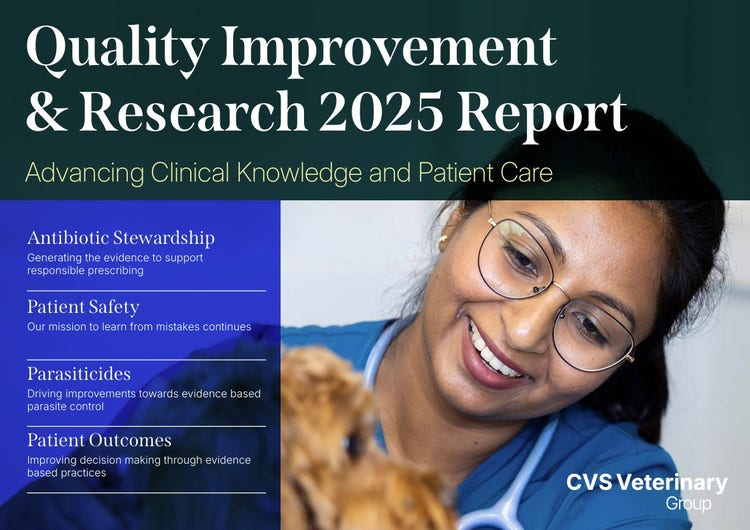
CVS Group has published its Quality Improvement and Research Report for 2025, demonstrating its commitment to improving patient outcomes, supporting clinical teams and advancing evidence‑based veterinary care.
Bringing together quality improvement (QI) and research insights into a single publication, the report highlights how data, research and frontline learning are being used to make care safer, more effective and more sustainable for animals, clients and colleagues.
It reflects a collective effort across CVS practices, laboratories, referral hospitals and support teams, and spans key areas including antimicrobial stewardship, patient safety, workplace safety, parasiticide prescribing, nurse skill utilisation and the responsible use of artificial intelligence in veterinary care.
Paul Higgs, Chief Veterinary Officer at CVS Group, said:
Antimicrobial stewardship is an important theme of the report, with a focus on responsible prescribing in companion animal, farm and equine. Highlights include progress in reducing antibiotic use, as well as strengthening our prescribing benchmark in companion animal from 2.3% of consultations resulting in an antibiotic prescription to 2%.
Angela Rayner, Director of Quality Improvement at CVS Group, said:
CVS also collaborated on research with leading UK universities as well as supporting teams with data, education and evidence‑based guidelines.
Imogen Schofield, Director of Research and Data Science at CVS Group, said
A section focuses on CVS Group’s ‘Learning from Mistakes’ mission, launched to strengthen psychological safety, improve reporting and ensure teams learn constructively when things don’t go to plan.
In research, key topics include a multi‑year workplace injuries research programme that has already driven evidence‑based safety changes — including a mandatory protective equipment policy in equine practice alongside new findings in parasiticide prescribing, nurse skill utilisation and environmental impact.
The report also provides forward-looking insight into emerging priorities, including the responsible adoption of artificial intelligence to support clinical note taking and reduce administrative burden, as well as ongoing PhD programmes focused on antimicrobial stewardship, parasiticide environmental impact and nurse role optimisation.
Together, the findings underline CVS Group’s long‑term commitment to continuous improvement — recognising that learning is ongoing and that progress is built through openness, collaboration and evidence generation.
The CVS Group Quality Improvement and Research Report is available to view online here.