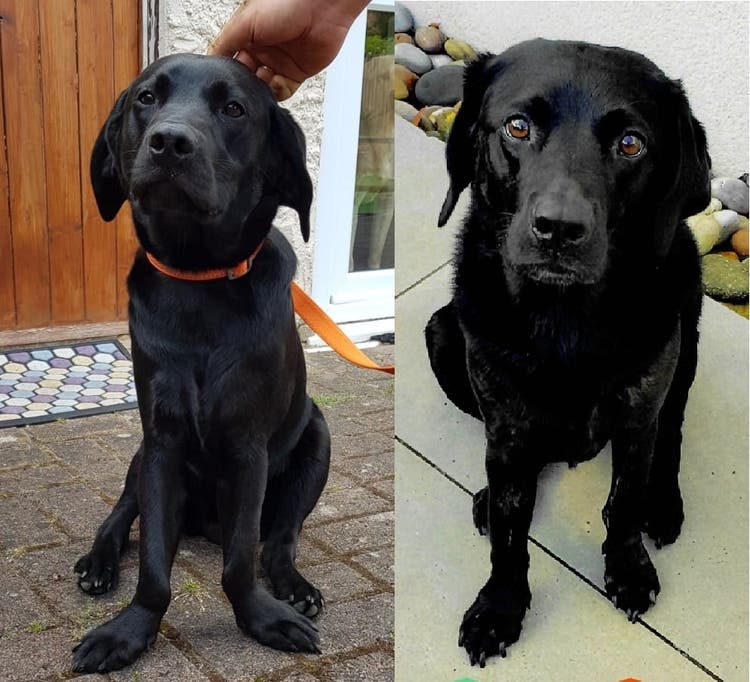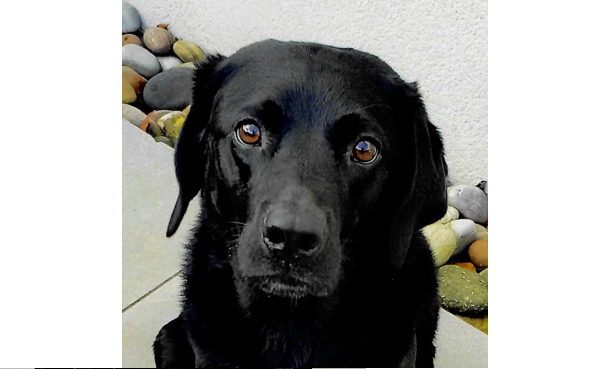
A family dog has been given the ability to run and play again, after a leading team of vets gave him pioneering new 3D-technology wrists and feet.
Floyd, a three-year-old male Labrador, developed a deformity of his forelimbs as a puppy with his wrists and feet turning severely outwards, meaning he found it difficult to walk.
Although Floyd managed without discomfort for a couple of years, he soon required pain killers to manage his condition, with his mobility progressively become more impaired.
Owners Greta White and James Walker, who live in Norwich, took Floyd to their local vets practice, who recommended that Floyd be taken to Grove Veterinary Hospital in Fakenham.
Here, one of the UK’s leading teams of animal orthopaedic surgeons conducted CT scans of Floyd’s front legs and feet to see if they could identify the problem. They determined that he was suffering from a forelimb deformity - known as carpal valgus and caused by a developmental asymmetric growth of the radius and ulna - resulting in his paws being turned outwards.
To treat Floyd, the team joined forces with Bill Oxley at Vet3D to plan the surgical correction of Floyd’s wrists. Using the CT scans, they digitally planned how Floyd’s bones could be precisely cut and realigned, then created bespoke state-of-the-art 3D-printed guides to perform the surgical correction.
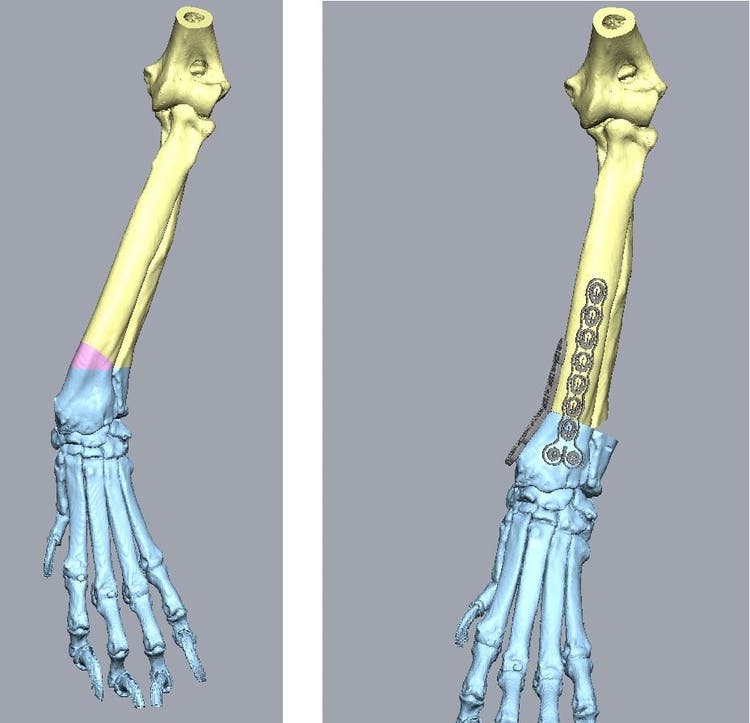
3D printed models before and after
The experienced orthopaedic team at Grove, led by European and RCVS recognised specialist surgeon James Tattersall, then performed the complex surgery on each of Floyd’s front legs in turn, with a four-week interval between. Using the 3D printed cutting and reduction guides, the bones were carefully realigned and stabilised with internal plates and screws.
Immediately following the first surgery, Floyd was brighter and more comfortable. Within days, he was able to start walking on all limbs. Over three months, he continued to recover smoothly and is now running around comfortably on his matching pair of new legs.